Take Care
A medical history that belongs to the patient.

- Services
- Design researchProduct and interaction designPrototyping in codeAgent experience
- Sector
- Healthcare
- Touchpoint
- Web appPatientDoctor
- Year
- 2026
Made with

Research
- 10Patients with 2+ conditions
- 5Caregivers
- 4Pharmacists
- 2Pharma company managers
- 1Local-LLM specialist
Your medical history, in one place.
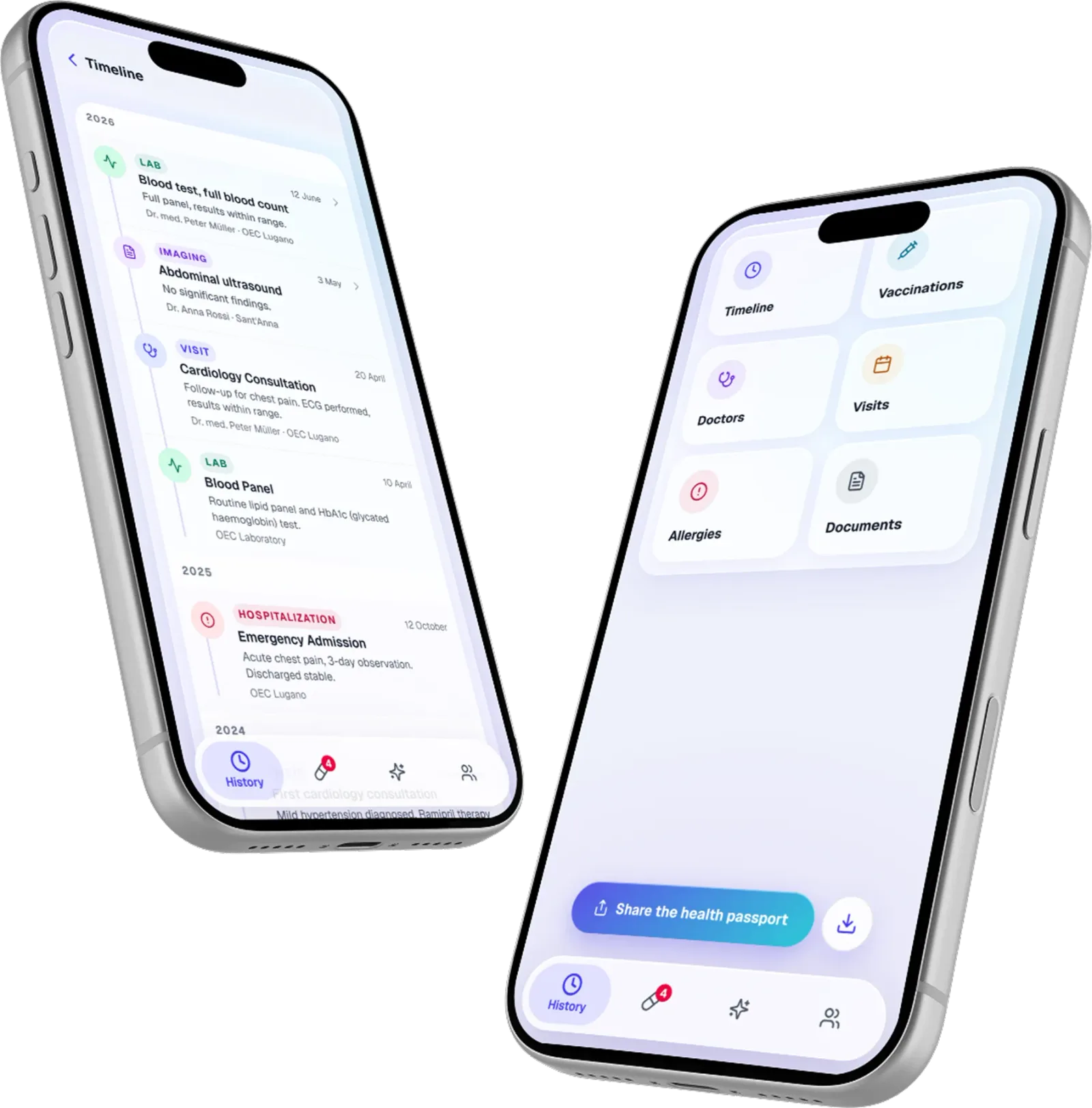
Take Care is a digital health passport that belongs to the patient, not to any single healthcare provider.
It works from a simple gesture: photographing a report, a prescription or a lab result. The system recognises the document, interprets what is in it, proposes where to file it and gives it a name that makes sense. The patient only has to confirm.
Over time the passport builds an organised medical history, and it can be shared with a doctor through a link with permissions and an expiry. The doctor installs nothing and creates no new account.
The project began as a prototype for hospital document intake. Through research and conversations with professionals and advisors it became a patient-owned product, positioned as a layer of intelligence and experience above the healthcare system that already exists.
Process
From a prototype for collecting documents to a passport the patient controls
In Switzerland the patient often ends up being the point of transit for their own medical history.
Reports, prescriptions and tests travel between the family doctor, specialists, hospitals and different providers. Languages, formats and separate cantonal systems are added on top of that.
The result is that every new healthcare professional risks having to rebuild the history of the patient from zero.
I took the first prototype to healthcare professionals and advisors. Their objections questioned some of the initial assumptions, and they drove how the product evolved.
The turning point was moving the question from “how can we help a healthcare provider collect documents?” to “who should own and control their own medical history?”
The answer became the patient.
How it works
A flow that moves the work from the person to the system.
The patient uploads
Reports, prescriptions and lab results, in any language or format
The AI organises
It recognises the document, extracts the information, structures it, translates where needed and links medication automatically
The doctor consults
A medical history already organised, which can be checked without re-entering anything by hand
Who uses it
Two portals, one history.
Take Care has two interfaces built around the same record.
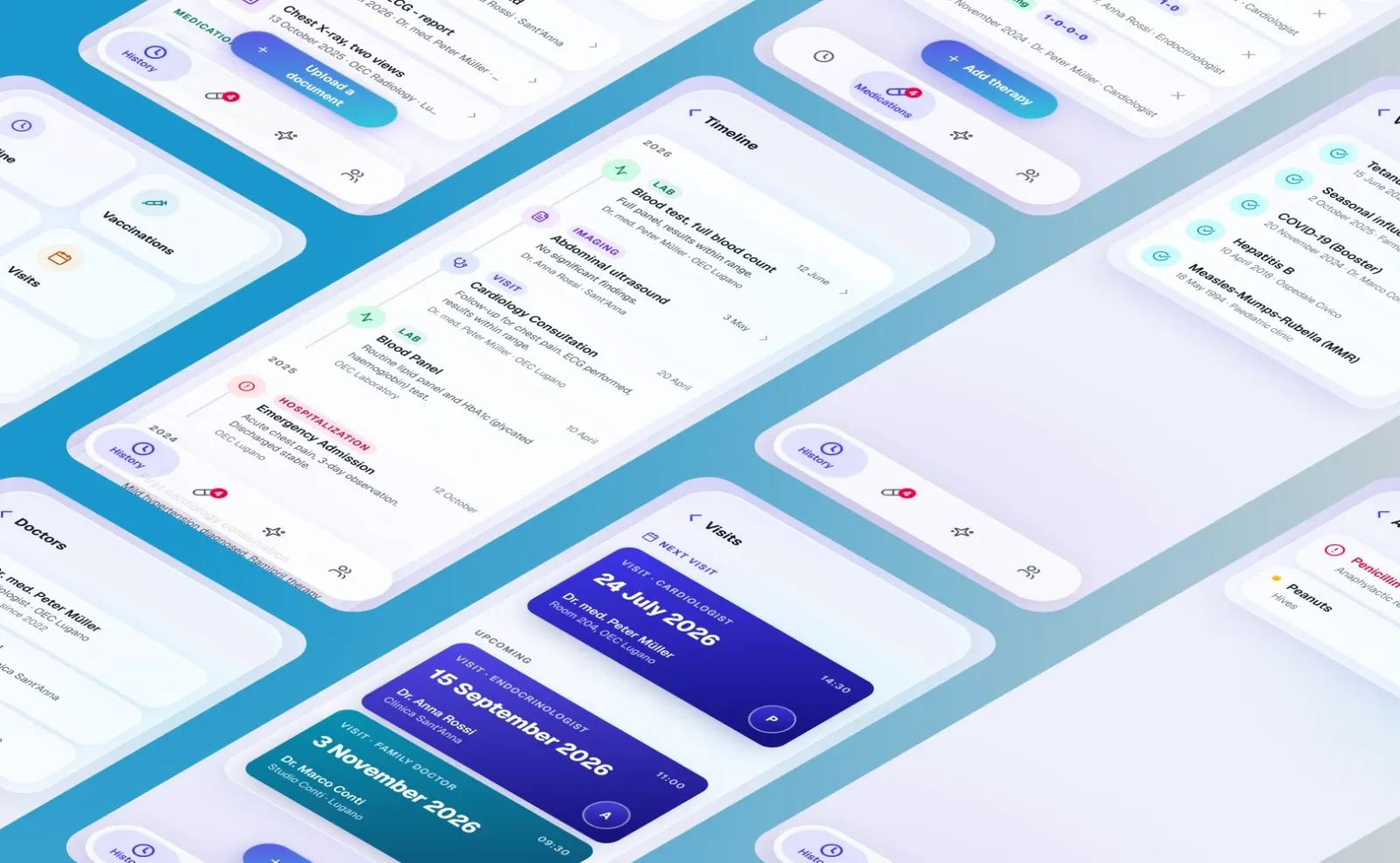
The patient portal is for adding documents, organising your own history, sharing it, and asking questions about your own information in plain language.
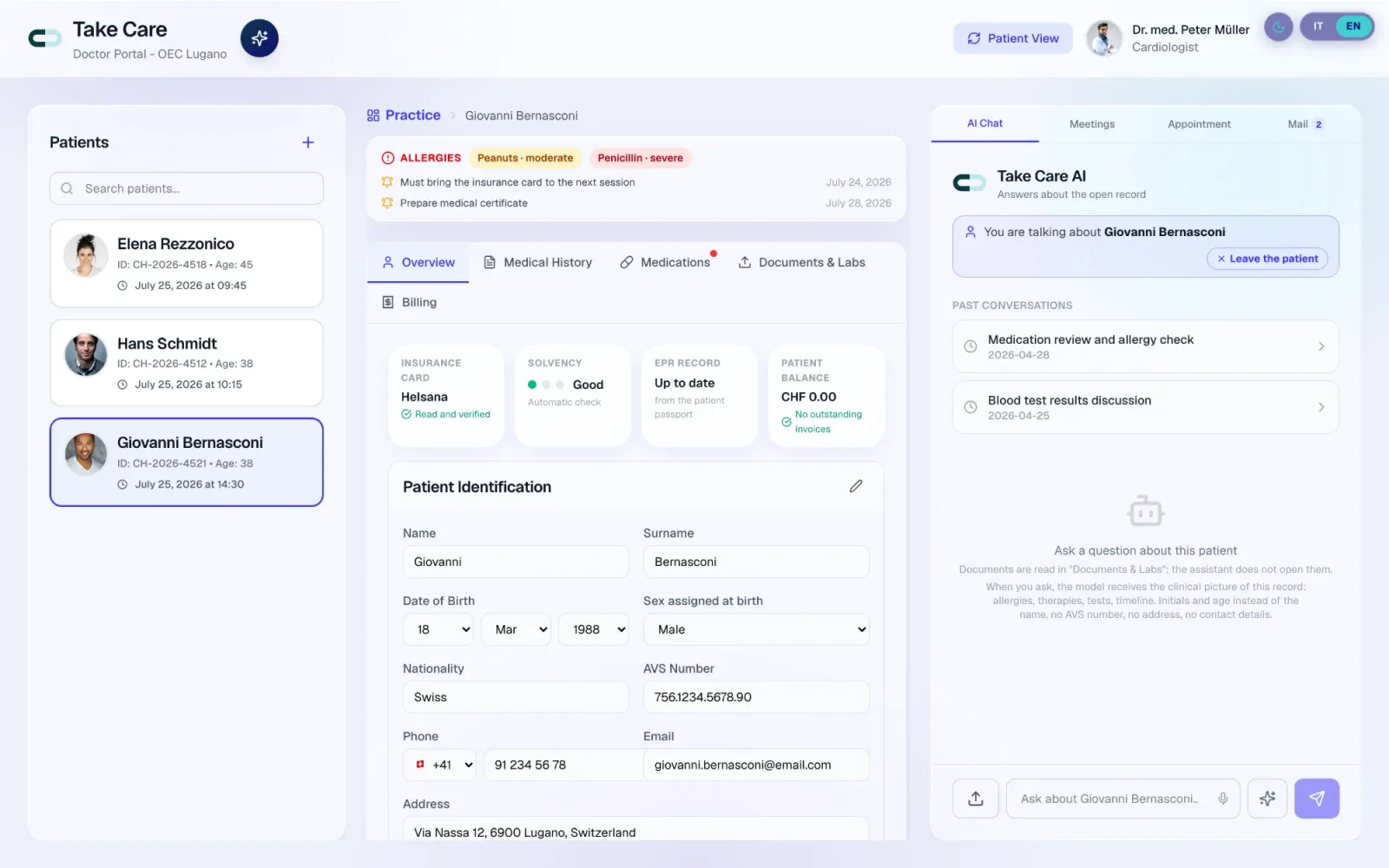
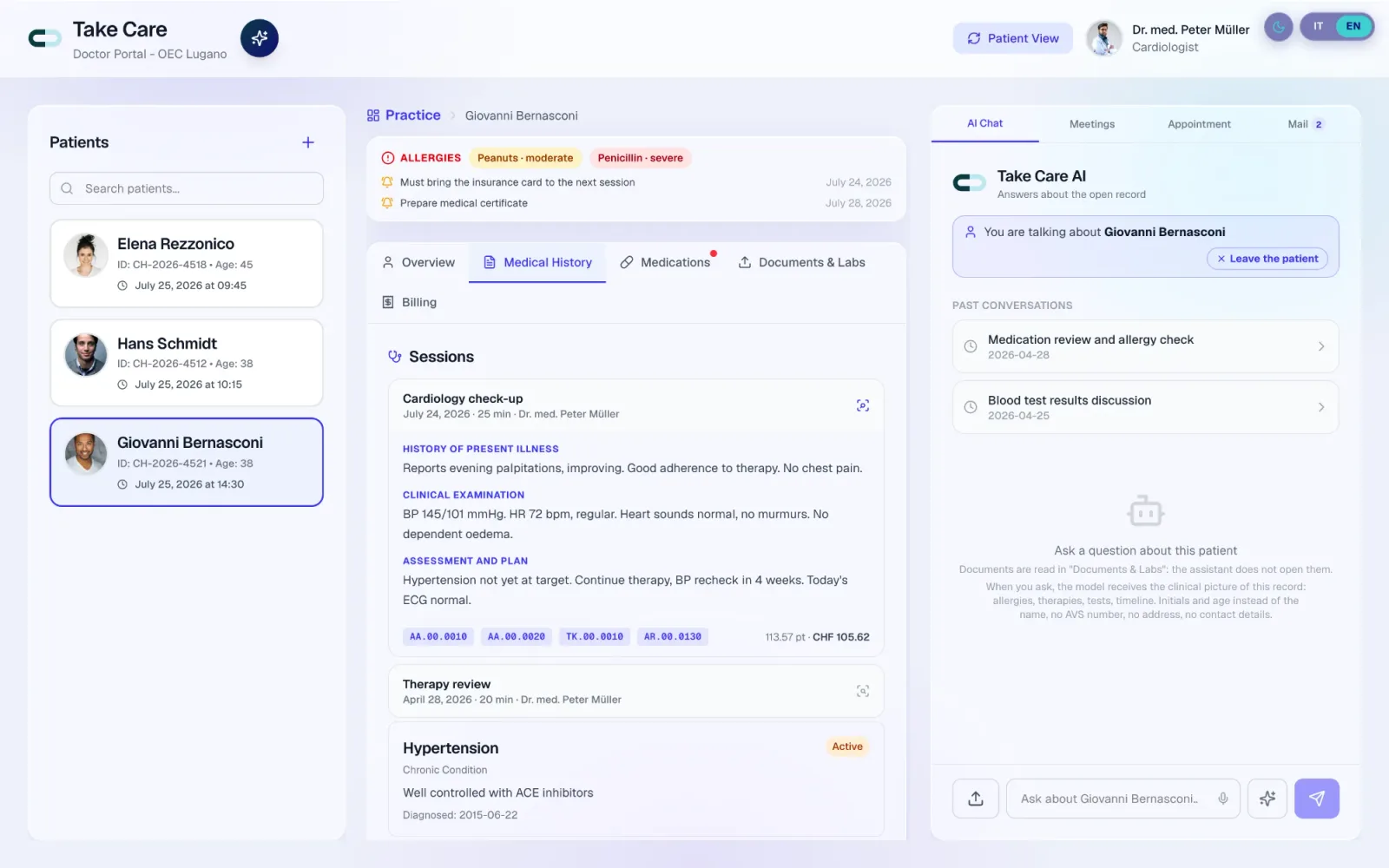
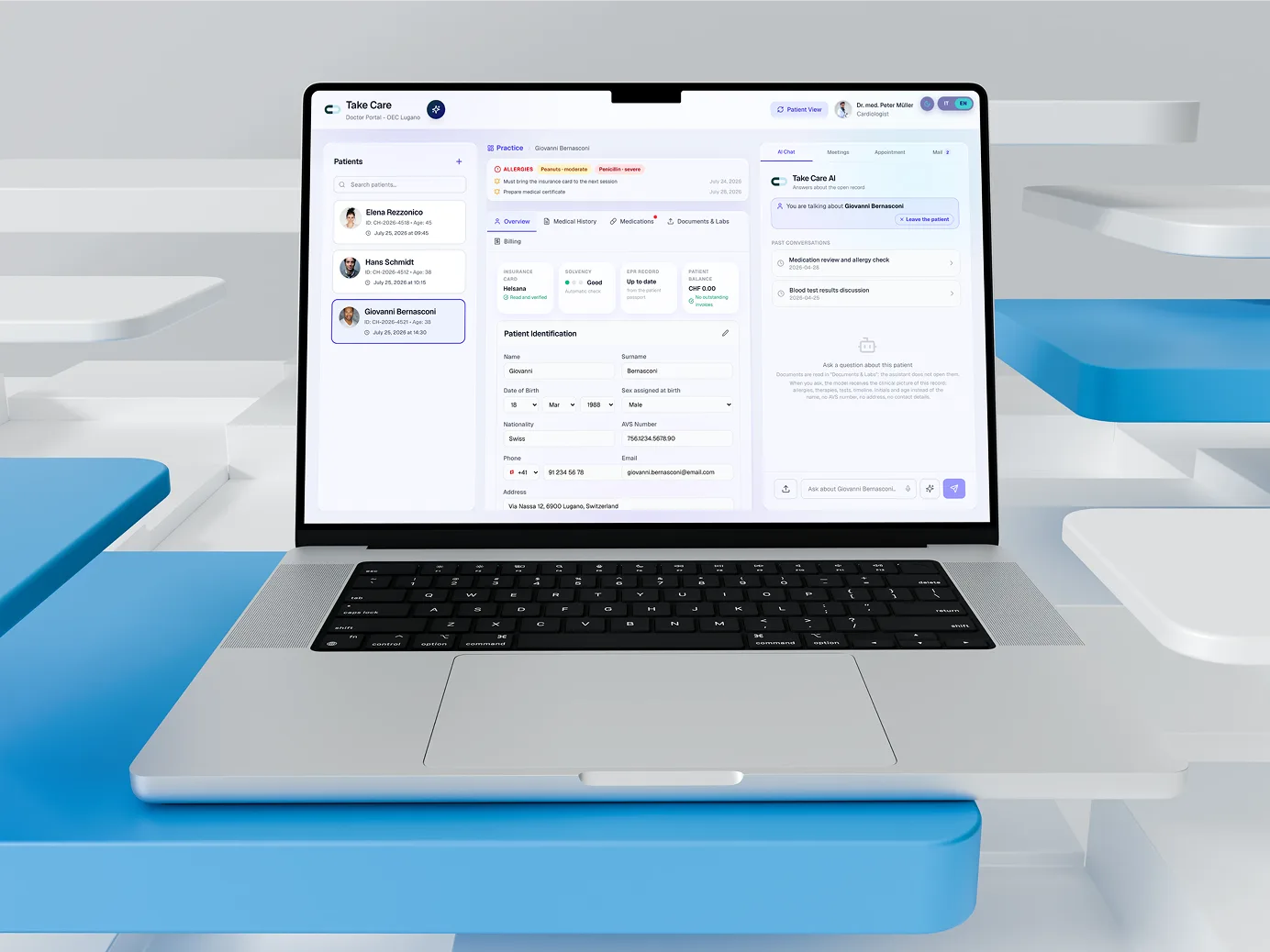
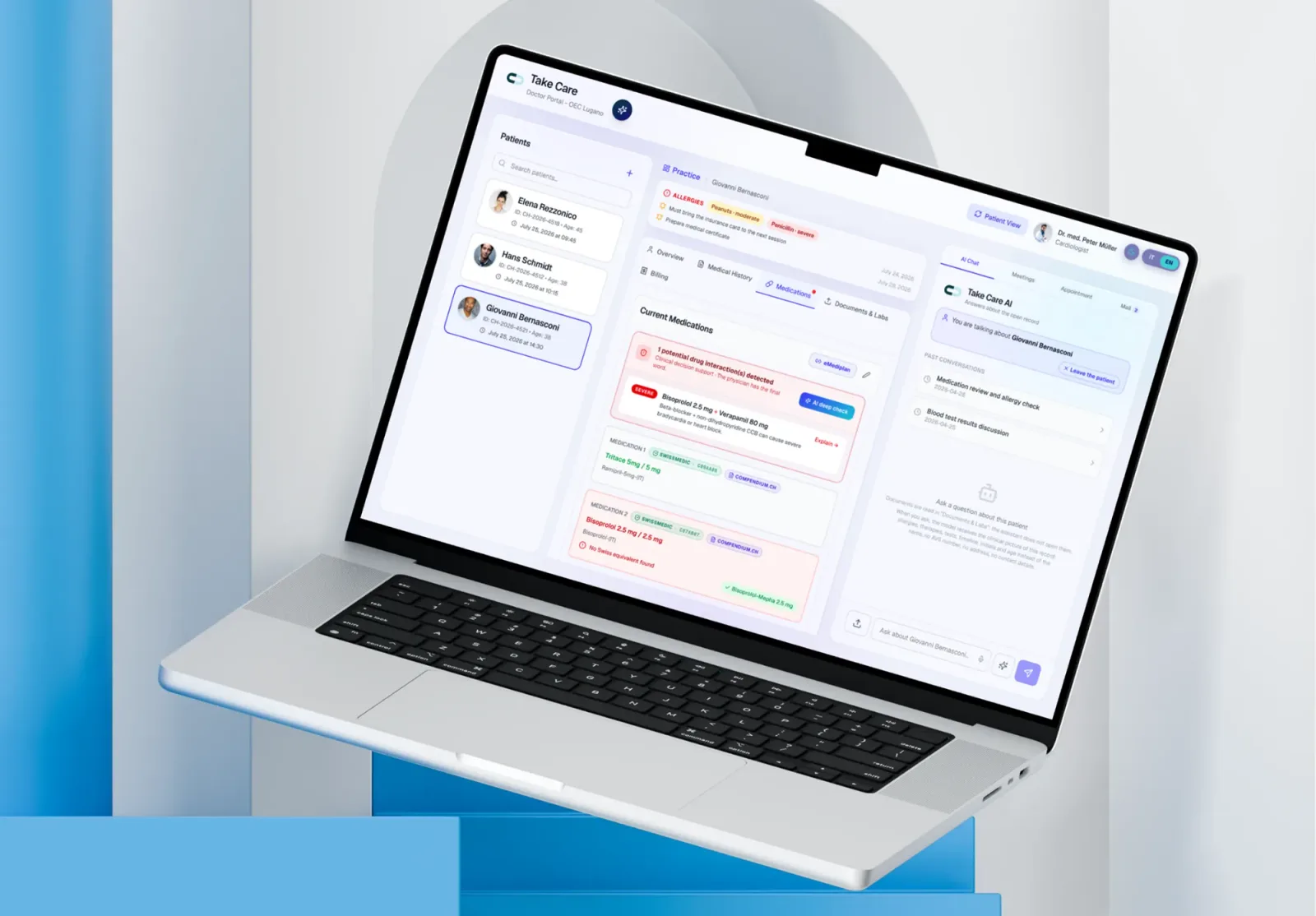
The doctor portal opens a shared record, shows the chronology and the medication in use, and offers an assistant that answers only from the information belonging to that patient.
The principle is simple: the same data changes interface depending on who has to use it.
Target user #1
The doctor
A healthcare professional who has to work with patients coming from different contexts, and to consult information that is often fragmented and multilingual.
Their main need is not more technology, but less time spent searching, translating and re-entering information.
“I want to focus on my work, not on managing data.”
Main needs
Target user #2
The patient
Someone dealing with a fragmented medical history, often spread across different providers and documents in more than one language.
Their need is not only to store the documents, but to carry them and make them understandable when they enter a new healthcare system.
Main needs
Solutions
Give the medical history to the person present at every visit
The patient is the only person who carries their own medical history from one doctor to the next.
That is why the record belongs to them.
Uploading a document is a patient action. Sharing it is their decision. Revoking access takes one gesture.
The doctor receives a link with defined permissions and an expiry. No installation, no new account, no training.
Sit above the federal health record, not against it
Switzerland already has the EPD, so building another archive would have meant duplicating something that exists.
Take Care takes a different role.
The EPD stores the data and lets it be shared. Take Care works on the level above: it reads, organises, connects, and makes that history usable.
The project does not try to replace the existing infrastructure, then, but to build on top of it a simpler experience and a layer of intelligence that helps both patient and doctor find their way.
Turn uploading into a single action
Asking a patient to classify a medical document is asking them to know a structure they probably do not know.
So the flow starts simply from a photograph.
Take Care recognises the kind of document, proposes the right section and generates a readable name. The patient checks and confirms.
The work moves from the person to the system, and the final decision stays with the person.
Handling the data follows the same principle. The OCR runs directly in the browser, so the image of the document can stay on the device. The language models can run on controlled infrastructure, which makes it possible to use the system without necessarily depending on external AI services.
Use the AI to see what the doctor cannot see alone
The goal is not to diagnose.
Over the years it is possible to end up with many medicines prescribed by different doctors, without anyone necessarily having a complete view of the therapy.
Take Care can read the whole list.
When a new prescription conflicts with what the patient is already taking, the system can flag the possible interaction and link it to the corresponding official entry in Compendium.ch.
The AI does not present a clinical conclusion of its own, then. It brings the information in front of the doctor, and makes the uncertainty explicit.
The system is designed with one precise rule: do not make diagnoses, do not speculate, and always require validation by the healthcare professional.
Live demo
Try both points of view directly.
The patient portal shows uploading and sharing your own history. The doctor portal shows how a shared record is opened, how the chronology is read, and how the information can be used during clinical work.
Outcome
A record that follows the patient, not the provider
The result is a working prototype of a digital health passport, with two connected experiences for patient and doctor.
But the most important outcome of the project was defining where Take Care can have a role in the Swiss healthcare system.
Not as a new archive competing with the EPD, and not as an artificial doctor.
Take Care becomes an intermediate layer: it collects the history of the patient, organises it, and makes it easier to understand and to share.
The patient keeps control of their own data, while the doctor receives a history already structured and ready to check.
The project also made some open limits clear: real interoperability with healthcare systems, clinical responsibility for AI recommendations, and handling sensitive data in a product meant for real use.