Kai
A companion for understanding your own body through a hormonal journey.
- Services
- Design researchProduct and interaction designAgent experiencePrototyping in code
- Sector
- Healthcare
- Touchpoint
- Physical deviceVoiceCompanion app
- Year
- 2026
Made with


Research
- 2On hormone therapy
- 2Living with PCOS
- 2On the contraceptive pill
- 1Endocrinology specialist
Answers about your body. None of them leave the room.
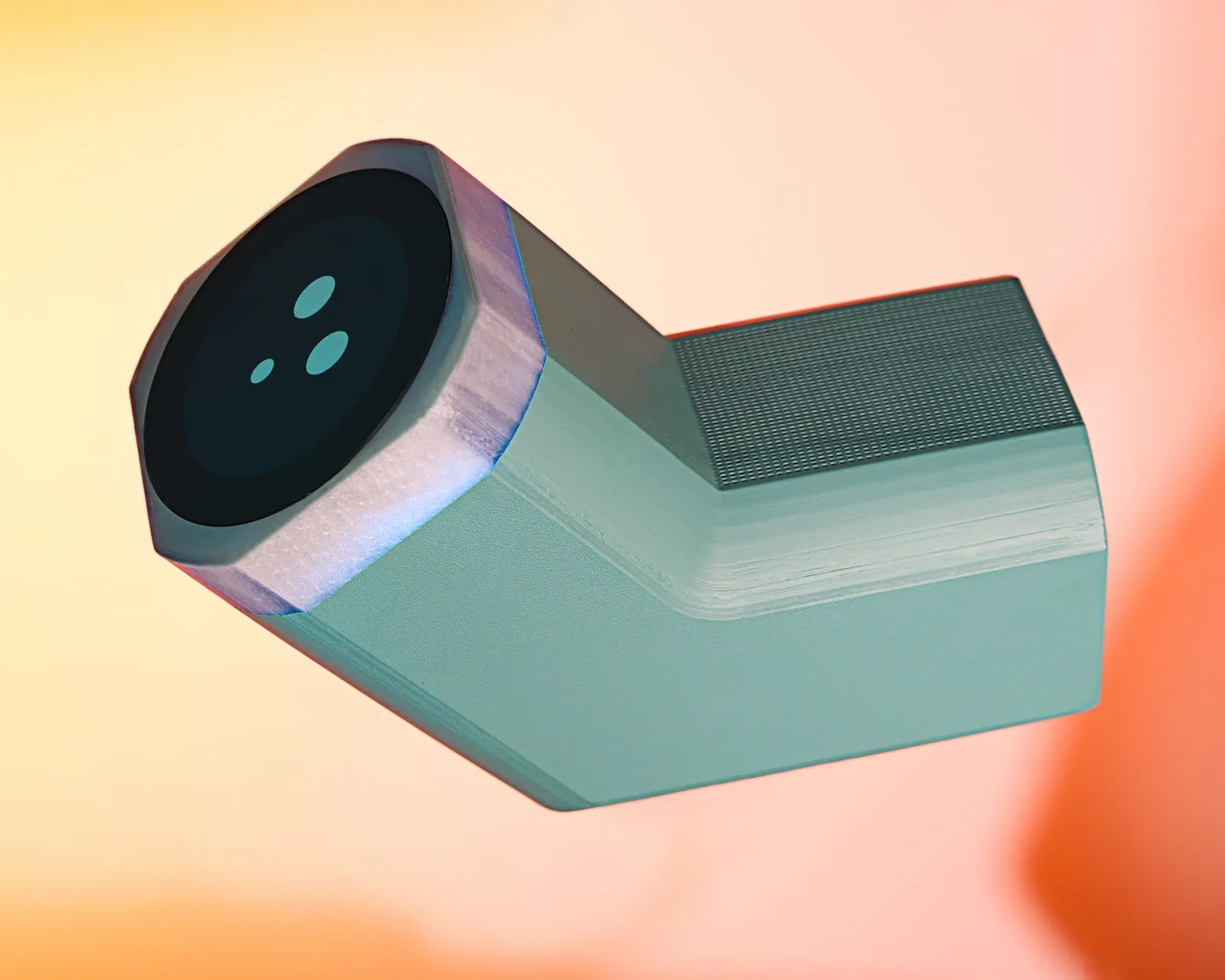
Kai is a small voice companion made for people going through a hormonal journey: gender-affirming therapy, contraception, PCOS, endometriosis or menopause.
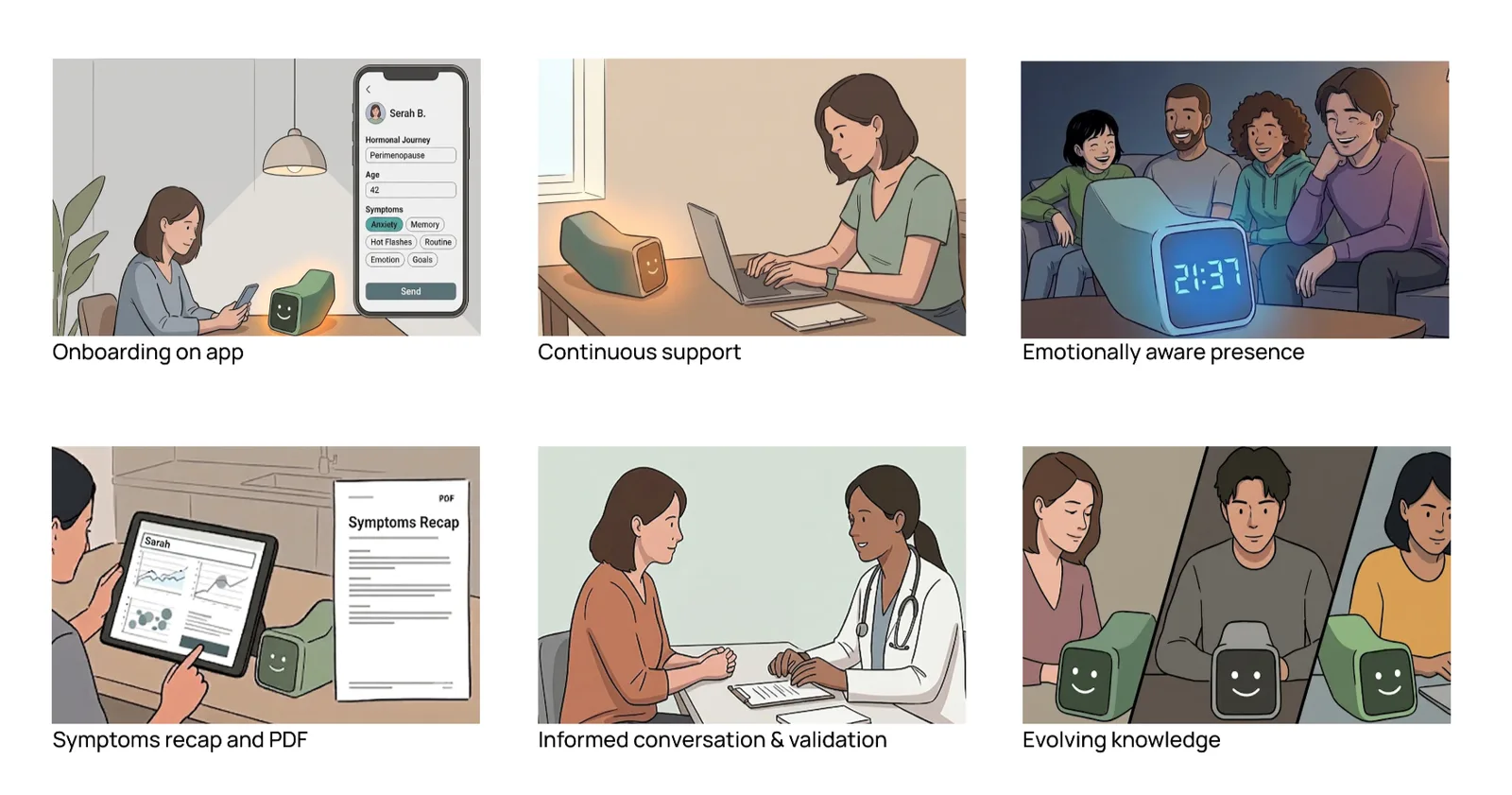
You talk to it as though you were thinking out loud. Kai helps you put a name to what you are living through, recognise connections between the things you have said over time, and add context to what you feel. It does not tell you what to do.
Its role is above all to collect and organise information that would otherwise risk being lost. Over time the conversations build a history of your own path, one that can be read back and turned into a summary to take to the endocrinologist.
Kai runs locally. The model, the speech recognition, the voice and the memory live on hardware controlled by the person who owns it, and no conversation has to reach the internet.
Privacy is part of the interaction too. Tipped towards you, Kai is awake and can listen. Tipped away, the microphone is off. There is no hidden state to interpret and no setting to check.

Process
Different conditions, the same difficulty: understanding what is happening.
We spoke with trans people at different stages of hormone therapy, people who were stopping or considering contraception, people with PCOS and endometriosis, people going through perimenopause, and an endocrinology specialist working in gender-affirming care. Some were living with more than one of these conditions at the same time.
The bodies and the symptoms were different, and the difficulty was surprisingly similar.
People look for information, wait for a symptom to pass, compare experiences online, or learn through trial and error. Often, though, they cannot tell what is normal from what is worth telling a specialist.
And above all, nobody wanted to turn into a researcher of their own body.
Nine insights came out of that research. Four had a direct impact on the design decisions.
Solutions
Make not listening a fact, not a setting
The form of Kai comes from a very concrete need: making it immediately clear when the device is listening.
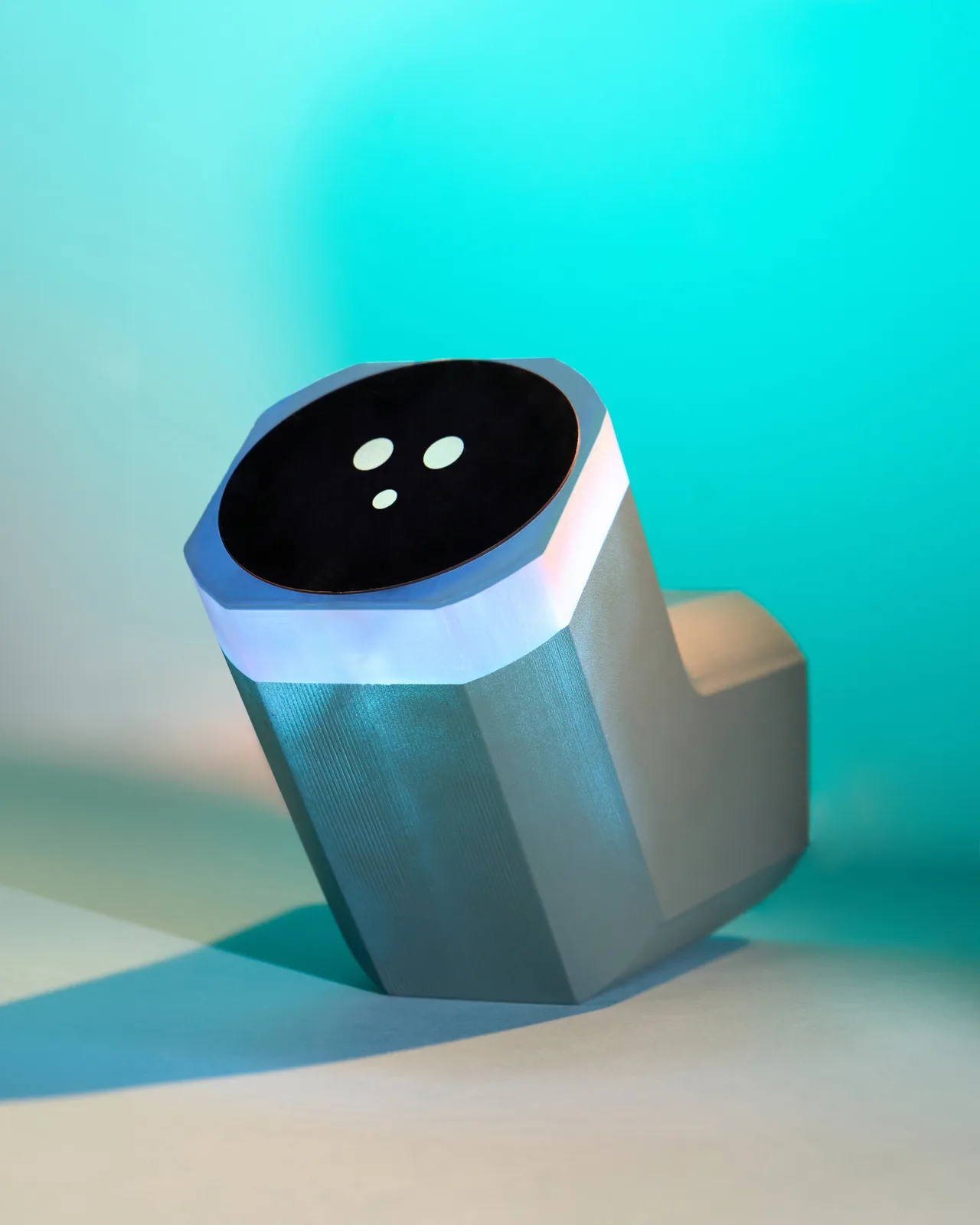
The body is a double cube with two resting positions. Tipped towards you it is awake and listening; tipped away it sleeps and the microphone hears nothing.
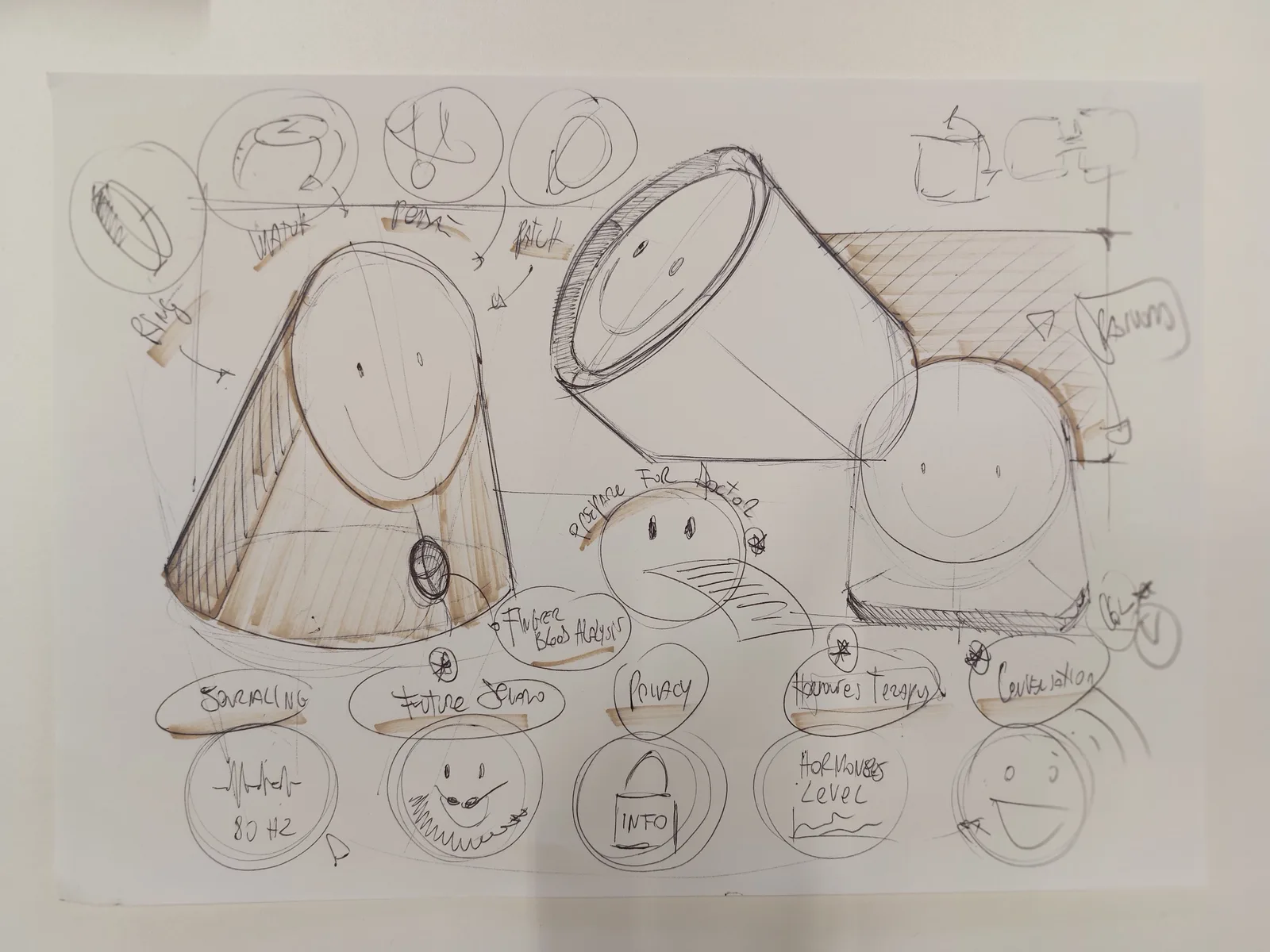
The solution arrived during the process and it changed the project. The first concept was a single cube, the same from every angle, which could not communicate its own state.
When privacy became a central constraint, the form had to take on part of the responsibility. Tipping is not only an interaction, then: it becomes a small gesture of consent.
Design the limits before the personality
Building an assistant that feels welcoming is relatively simple. The problem is designing an assistant that knows when not to intervene.
Kai works in a particularly delicate context. People can arrive confused, worried or vulnerable, often before they have had the chance to speak to a doctor.
For this reason an important part of the design went into defining what Kai must not do.
It does not make diagnoses, not even when it is asked to. It does not go along with self-destructive thoughts. It does not present self-medication as a safe solution. And when a person starts using Kai as a substitute for human care, it says so explicitly.
These behaviours are guided by twelve principles defined together with an endocrinology specialist and written into the system prompt. Among them: validate before informing, explain the mechanisms instead of reassuring, be transparent about uncertainty, do not assume what the person is aiming for, recognise a crisis immediately, and build understanding without creating dependence.
Keep the whole stack inside the house
Many companion devices are, in effect, microphones connected to somebody else’s cloud.
Kai starts from the opposite assumption: if the conversations are about your own body, they should stay under your own control.
The system uses an open-weights model run locally, together with the speech recognition, the neural voice and the memory system. Voice in, processing, voice out and memory over time are handled on the same machine, without the conversations having to leave the home network.
The engine holds no permanent memory of its own. For each conversation it is given the personality and the relevant information, and when the conversation ends it does not keep it.
The health information is collected instead in simple local notes that the owner can read, edit or delete.
Remote access follows the same principle: the server exposes no inbound ports, and instead establishes a connection outwards through an encrypted tunnel. The companion authenticates with a signed token, and the base model stays swappable, so the system is not tied to a single provider.
The most essential face that can still be someone
The front of Kai is a circular display with two eyes and a mouth.
A realistic face would have introduced gender, age and features to interpret. Two eyes and a mouth leave room for the person using it.
The face communicates mainly through movement.
When Kai sleeps it becomes a clock. Waking, it blinks and returns to a resting state, breathing and looking around. When it hears its own name, the eyes brighten and wait for the person to start talking.
While it listens it stays still. When something is added to memory a small notepad appears: remembering becomes visible, and never happens behind the user’s back.
When it does not understand something, it does not pretend that it has. A slower blink, a tilt, or a small questioning sound make the uncertainty part of the interaction.
The motion is defined once and then rendered in two environments, the browser prototype and the firmware of the physical display, from the same states and the same timelines.
The face stays deliberately flat: no gradients, no shading. The only luminous element is the functional ring, so every light says something.
Live demo
Try it yourself. It is running in the page.
Every state the face can be in, running. Wake it, let it listen, watch it think, or play the whole flow through.
Turn awareness into the outcome, not the entry price
Kai does not ask the user to keep filling in questionnaires, track symptoms, or build a diary by hand.
The starting point is much simpler: talking about what is happening.
One conversation can help find a word for something that was hard to name before. Over time, more conversations build a wider picture: Kai can connect what is said today with what was said weeks or months earlier.
What comes out is not a score or a diagnosis, but a more readable story of your own path.
When the moment comes to speak to a specialist, the companion app can turn that story into a structured summary to share with the endocrinologist.
In this way Kai does not try to replace the clinical relationship. It tries to make it better informed.
Outcome
A working device, and a clear list of what it still does not solve
The project produced a working physical prototype, able to run the voice interaction end to end locally.
The concept was also reviewed with a representative of an organisation active in open health, who confirmed the need and particularly appreciated the choice of making switching the microphone on and off physical.
At the same time, that conversation questioned one of the most visible choices in the project: the face.
And that is exactly one of the questions that stay open. How much should a device be “someone”, when in a health context it should above all help you understand yourself better?